I once found myself somewhere that looked like a dead end. Then the narrator in Call of Juarez: Gunslinger said something to the effect that he hadn’t noticed a path there earlier. Suddenly, the path appeared. The funny thing is, I hadn’t seen it a moment earlier either. How could I have seen it when it only appeared after he mentioned it?
That’s what listening to the story in this game feels like. Imagine someone hanging out with friends, telling them about his exploits. Someone interrupts because they remember things differently, and then the storyteller takes over again. The difference here is that I’m playing through the very events they’re arguing about. As long as they could keep twisting the story like that, I wanted to see where it would take me, even after I’d begun to recognize the gameplay loop.
I played Call of Juarez: Gunslinger on PC through Steam, using a keyboard and mouse on Normal difficulty. It took me 4 hours and 40 minutes to finish the campaign and see both endings. Afterward, I tried Arcade and Duels once each. Of the three modes, I enjoyed the campaign the most. A duel could make me tense when it came up in the story, yet when there was an entire mode dedicated to playing duels over and over, I had little interest in continuing.
Call of Juarez: Gunslinger Video Review
You can watch the narrated video version of my review below. It covers the game in some depth, although it is not as detailed as the written review on this page. The video is presented in Indonesian. Click here to watch it on YouTube.
The most entertaining part of Call of Juarez: Gunslinger is how the story is told
Usually, when I fail to beat a boss, I think about what I need to do differently on my next attempt. Here, a failure like that might be met with a remark from the narrator reminding everyone that he didn’t die back then. I like the humor because it makes sense from both perspectives. I’ve just failed, but the man whose story I’m playing through is still sitting there telling it. Obviously, both our experiences can’t end there.
Something similar happens when someone else starts telling their version of events and the narrator corrects a detail he thinks they’ve gotten wrong. For me, that’s where Call of Juarez: Gunslinger works best. If they were simply arguing with one another, the dialogue would already be funny enough. Once those corrections started changing the places I was passing through, I had a reason to pay attention to what they were saying while playing my part. All that tall talk turns out to be pretty useful when you’re trying to find your way.
Even so, I enjoyed how the story was told more than the conflict behind it. I knew the protagonist had a personal score to settle with someone, but I never felt that I got to know either of them or the world they inhabited in much depth. What interested me more was his reputation. Throughout Call of Juarez: Gunslinger, I heard people talking about the protagonist. By the end, I had formed my own opinion of the kind of man he deserved to be remembered as.
Of the two Call of Juarez: Gunslinger endings, I prefer Redemption. To me, there’s a difference between making a name for yourself because people fear you and being remembered as someone who could still make his own choices. I preferred the impression that choice left on me, even if the conflict leading up to it wasn’t particularly deep. To see the other ending, I only had to load my last save and replay the final chapter. I didn’t need to repeat the entire campaign.
By the halfway point, I knew what came next
Around the halfway point of Call of Juarez: Gunslinger, I could start guessing what I’d be doing next. Walk for a bit, get attacked or start shooting, move around some more, and then have a duel. Not every section followed that exact sequence. It’s just the pattern that stands out when I think back on what I did from one section to the next. What I still couldn’t predict was which version of the story I’d hear along the way.
On Normal difficulty, I found most gunfights manageable, although I had to retry a few sections. One that sticks in my mind left me confused rather than struggling to aim. An enemy with a Gatling gun was stationed in front of a railway tunnel. I died several times before realizing all I had to do was throw an explosive at him. It was a little way behind me, and I’d walked right past it. When I think back to that section, what comes to mind is how close I’d been to the thing I needed while I was busy dealing with the enemy ahead.
When it comes to reflexes, there are two things I like in Call of Juarez: Gunslinger outside the duels. Sometimes I have to press a button quickly to finish off an enemy. If I miss it, the opportunity is gone. At other times, when I’m close to death, I have to move my character left or right to dodge a bullet. One gives me a chance to take down an opponent, while the other asks me to save myself. Duels call for a different kind of reflex altogether.
Two pistols or one? I’ll take one
Playing Call of Juarez: Gunslinger with a keyboard and mouse, I felt comfortable moving and aiming. What took a little getting used to was switching from one pistol to two. Even after I got the hang of it, I preferred going back to a single pistol. The reason is simple: I could aim more accurately with one pistol in hand. For my playstyle, that was more useful than carrying two at once.
The weapons I came across included pistols, shotguns, and rifles, with roughly two or three models of each type from what I saw. The Ranger was my favorite pistol. Its shots felt accurate, and the damage was satisfying, although it was a little slow to reload. My second choice was a rifle. I liked using it at long range, but I was still comfortable with it when enemies got close. Its main drawback was also the slow reload.
That’s why skill upgrades made more of a difference to me in Call of Juarez: Gunslinger. With two favorite weapons that both took a while to reload, I appreciated a faster reload speed. Increased damage and the slow-motion ability also made a noticeable difference during play. Finding another weapon model didn’t necessarily make me want to swap out the Ranger or the rifle, whereas I could feel the benefit of upgrades without changing my preferences.
Duels were my favorite, but I didn’t want to keep replaying them
During a duel in Call of Juarez: Gunslinger, my character stands still, but both my hands are busy. With my hand on the keyboard, I manage how quickly my character draws his weapon. At the same time, my mouse hand keeps the cursor focused on the opponent. When the moment comes, I have to click as quickly as possible to fire. The tense part is the few moments before that click. It isn’t time to shoot yet, but I can’t just sit and wait, either. Even while concentrating on my character’s draw speed, I still have to make sure the cursor is pointing where I want it when it’s finally time to fire.
Duels were among my favorite parts of the campaign. Unfortunately, even when the next opponents got faster, the way I dealt with them remained more or less the same. I had to be more precise with the controls and quicker to shoot, but I wasn’t facing a new problem that forced me to play differently. I still enjoyed it when a part of the story culminated in a duel. Replay duel after duel once the story was over? By then, I’d had enough.
That was also my first impression when I tried Duels mode in Call of Juarez: Gunslinger. It felt much like the duels in the campaign, except now the duel itself was the entire reason to keep going. Arcade offers a different objective: getting as high a score as possible in as little time as possible. I’m not someone who enjoys repeating the same action to improve a time or score. I only tried each mode once, so what I can tell you is why I stopped, rather than how long they might entertain someone who enjoys chasing records.
The pre-duel sketches stayed with me more than the gunshots
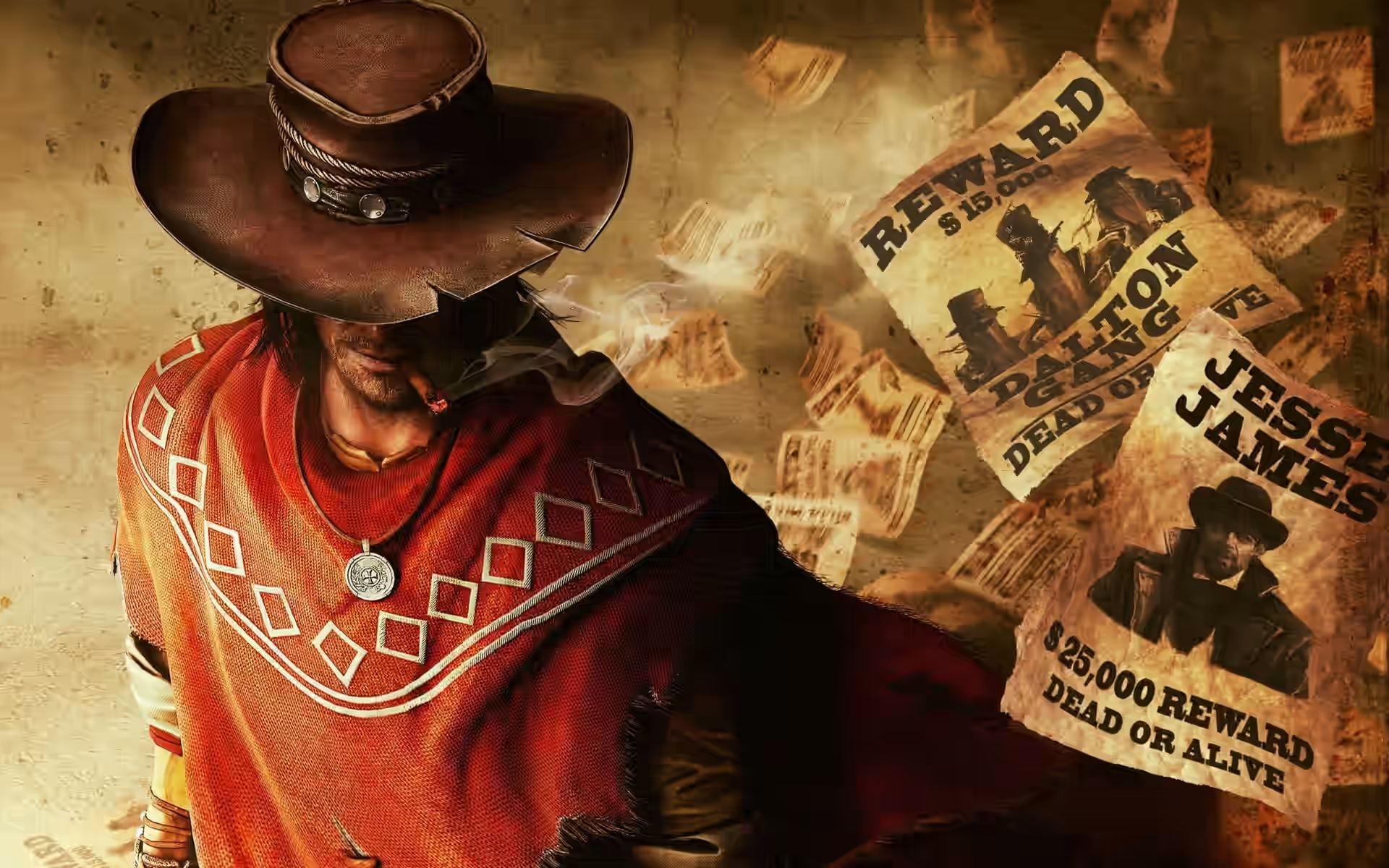
To my eyes, Call of Juarez: Gunslinger still looks good in 2026. Its environments reminded me of Western movies set in old Texas, although no particular location stood out visually. The 3D enemy models still look fine, too. But if I had to pick the visual detail I remember most, it would be the 2D sketches of the bosses and protagonist before each duel. Their Western cartoon style looks especially cool in those illustrations. For me, that’s where the game finds a distinctive look beyond the more ordinary impression I got from the environments themselves.
As for the audio, what I most wanted to hear in Call of Juarez: Gunslinger was the characters talking. The background music didn’t leave much of an impression on me, and neither did the gunshots or environmental sounds. The voice acting held my attention without feeling exceptional. What kept me listening was what they were saying: when someone would interrupt, which detail would be disputed, and how the tale would continue. Without those conversations, I think the stretches between gunfights would have felt much duller. I didn’t encounter any disruptive technical issues while playing on PC through Steam.
Worth buying, but wait for the right price
I bought Call of Juarez: Gunslinger for Rp20,600, down from Rp206,000 at the time. At the price I paid, I was satisfied even though 4 hours and 40 minutes was enough to see both endings. What I paid for was primarily the experience of finishing the game once. In that time, I’d become comfortable with my two favorite weapons, enjoyed the duels, and noticed when the recurring pattern started to wear thin. That was enough for me, without needing to chase high scores just to get more hours out of the game.
At the full price of Rp206,000, I wouldn’t recommend it. Even around Rp100,000 still feels a bit expensive to me. There are Arcade and Duels modes and the option to replay on a higher difficulty, but I didn’t feel the need to return after my curiosity about both endings was satisfied. Players who enjoy improving their draw times or chasing high scores might get more out of the same purchase. For me, around Rp20,000 is the sweet spot; anything below Rp60,000 is still worth considering.
I’d still recommend Call of Juarez: Gunslinger on sale if you enjoy first-person shooters that reward quick aiming and duels that demand precise timing. If you’re after a story with deeply developed characters and worldbuilding, don’t buy this game solely because I praise its narrative. What I remember after finishing it isn’t the complexity of the protagonist’s troubles. I remember standing at a dead end and being able to move on because the narrator mentioned a path he’d previously overlooked. For Rp20,600, I’m glad I listened to his tall tales all the way to the end.
Related reading: DOOM (2016) Review: Brutal Combat, Frustrating Crashes.