I find Journey fairly unique because it doesn’t try to impress players with complicated systems, intense combat, or a long story full of dialogue. It does almost the opposite. It’s simple, gentle, offers very little explanation, and relies more on the atmosphere of traveling. Playing Journey feels like following a short, wordless fairy tale in which you have to interpret what is happening for yourself.
I played Journey on PC with a keyboard and mouse and finished only the main story. This review covers my experience with the gameplay, exploration, visuals, symbolic storytelling, audio, technical performance, price, value, and final recommendation. My opinion is positive but still critical. Although Journey is an interesting game worth trying, I didn’t find the experience powerful enough to stay with me for very long.
Journey is a simple game you can finish in a short time. My playthrough took around two hours, and depending on how you interact with it, you might even finish in under an hour. That makes its value heavily dependent on price. I bought it myself on Steam during a sale, and at that price, I think it was worth it. But because it’s essentially a game better suited to one playthrough, I’d recommend buying it on sale.
Journey Review in Video Form
Watch the video version of the review below. If you prefer watching to reading, click here to open it.
Gameplay
Journey’s gameplay is extremely simple. From the beginning, it’s a relaxed experience with uncomplicated controls. You walk, explore a little, follow the path, and take in the atmosphere. No system demands much thought. There is no major combat and no complex mechanic. Everything is lightweight and easy to understand.
Relaxed Gameplay with Simple Controls
My first impression of Journey’s gameplay was that it felt relaxing. The controls are minimal, and the game is easy to understand immediately. Your destination is clear, so I didn’t feel lost. Keyboard and mouse controls were comfortable, and character movement felt smooth.
Journey doesn’t demand quick reflexes or strategy. It mostly invites you to follow a path. You can wander around a little, but structurally it’s still a linear game. You’re guided toward certain destinations rather than given the freedom of a large exploration game.
To me, that simplicity is a double-edged sword. It makes Journey accessible to almost anyone, but the gameplay is also too simple to leave a lasting impression. It stays basic from beginning to end. There isn’t a major change in mechanics that makes the experience develop dramatically.
The Best Part: Sliding Through the Desert
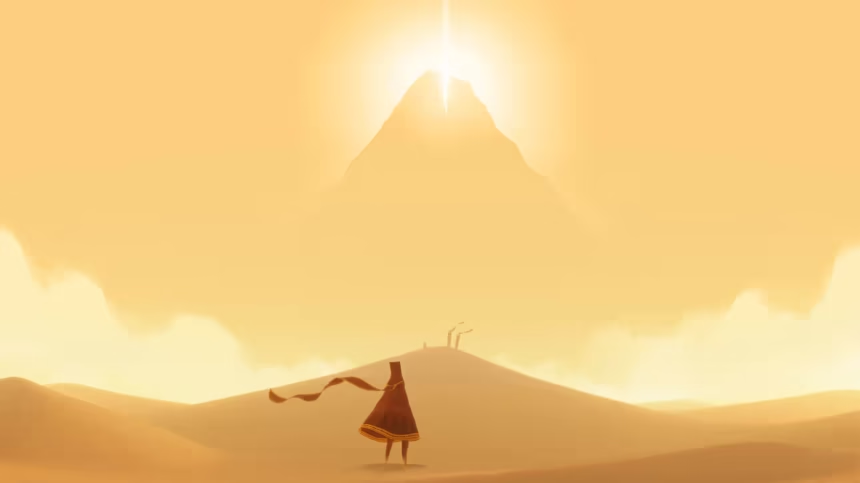
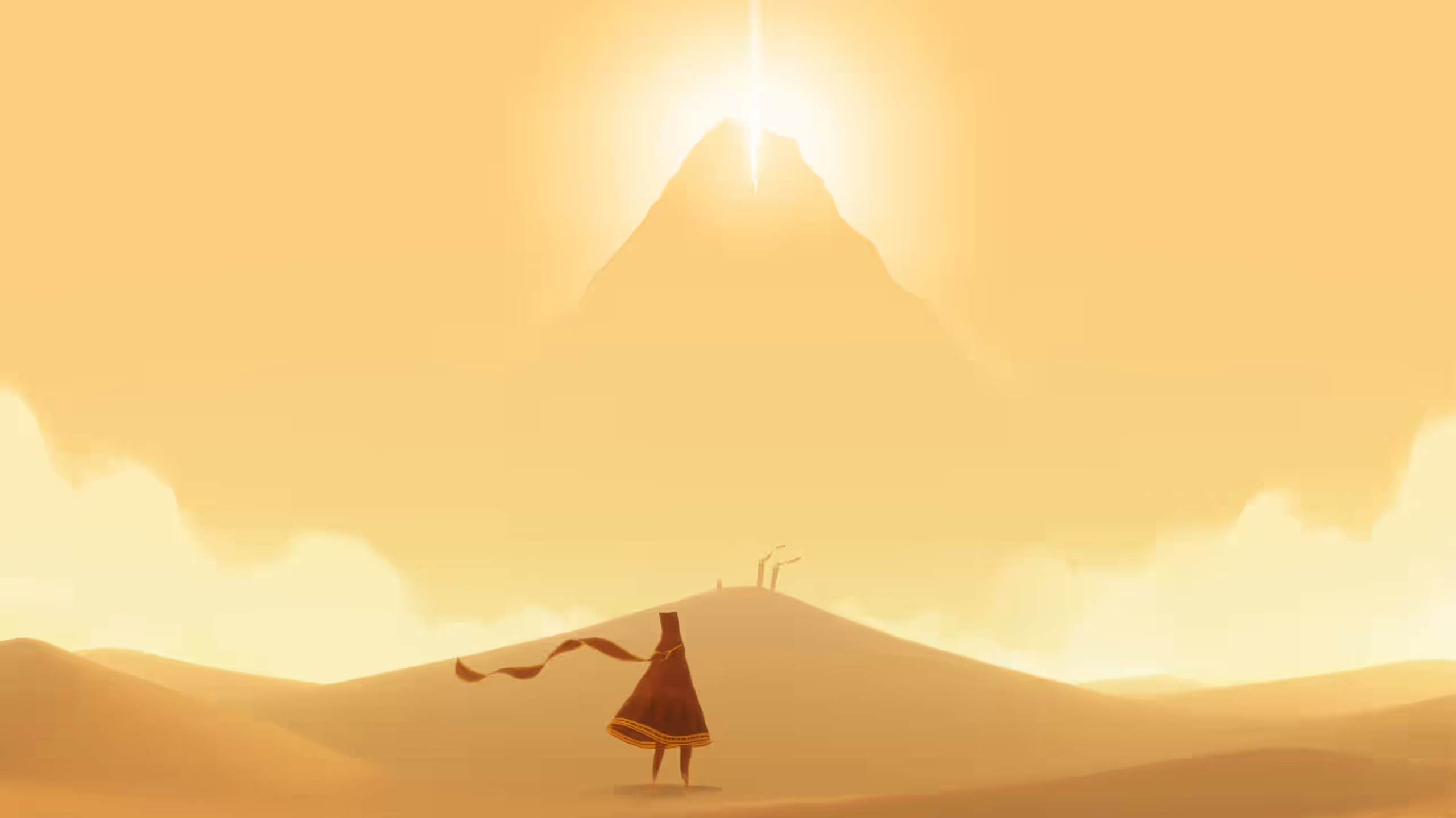
My favorite gameplay section was sliding through the desert. I enjoyed it most because the scenery looked good and the movement was satisfying to watch. Of everything in Journey, this sliding section was one of the most memorable moments for me.
It’s also the clearest example of how Journey’s simple gameplay can work well. You don’t have to do anything complicated. Just move, follow the flow, and enjoy the combination of visuals and travel. Moments like this show Journey at its best as a game built around atmosphere.
Gameplay Too Simple to Leave a Lasting Impression
The problem is that the gameplay is too basic to stay interesting for long. I can’t think of a gameplay mechanic that genuinely amazed me. Nothing specifically bored or annoyed me, but not much made me want to keep thinking about the experience after finishing either.
That’s why Journey faded from my memory fairly quickly. Not because it’s bad, but because there isn’t a particularly strong gameplay system or moment. It feels more like a brief, pleasant experience that doesn’t stay with you for long afterward.
Exploration and Pacing
I found the exploration in Journey limited. It’s not about wandering through a huge world with many branching paths, secrets, or side activities. Instead, you move toward your destination, take in an area, enjoy the atmosphere, and continue.
A Linear Journey That Still Sparks Curiosity
Despite the limited exploration, Journey’s world kept me curious enough to move forward. The destination is clear, and the pacing feels right from beginning to end. It doesn’t feel too slow or unnecessarily stretched out.
I think the short duration is one of Journey’s strengths. If the game had been made longer without genuinely new content, the experience might have suffered. Because the gameplay is so simple, a short and focused journey feels appropriate.
Memorable Moments Along the Way
Two sections of the journey stand out in my memory. The first is sliding through the desert. The second is pushing through snow between mountain cliffs. Both bring a distinct change in atmosphere.
The desert section is prettier and more enjoyable to look at, while the snow creates a sense of a harder journey. Together they make Journey feel like more than traveling between points, suggesting a symbolic journey with shifting moods.
Not Empty, but Not Especially Deep
I didn’t find any section especially boring or empty, but the exploration didn’t feel particularly deep either. Journey maintains a good rhythm, yet I wouldn’t describe its world as especially rich.
I see Journey’s exploration as a way to support the atmosphere rather than an attraction on its own. It works better as a short journey than as a truly expansive exploration game.
Visuals and World Design
Visually, I think Journey looks good, but not amazing. Its art style is simple, perhaps ordinary when judged by complexity, yet it has its own character. It doesn’t look strikingly modern today, but its visual simplicity feels distinctive.
A Simple Art Style with Its Own Identity
Journey doesn’t rely on realistic visual detail. Instead, its simple shapes, colors, and atmosphere matter most. I wouldn’t call the art style extraordinary, but it does have a recognizable identity and suits the symbolic journey the game is trying to present.
If you ask whether the world design, desert, buildings, lighting, and other areas are especially impressive, my answer would be no. The desert sliding section is still the visual highlight I remember. Elsewhere, the scenery is good but rarely astonishing.
Pleasant Visuals Without a Strong Emotional Impact
Journey’s visuals were pleasant to look at without creating a powerful emotional response for me. I wasn’t deeply moved by them. Still, they matter because without that simple, distinctive presentation, the experience would feel considerably flatter.
One small visual detail I found odd was the character’s pointed feet. I don’t know whether that was an intentional design choice, but it caught my attention. I don’t consider it a serious flaw.
Story and Characters
Journey’s story leaves plenty of room for interpretation. The game offers very little direct explanation. There is no dialogue spelling everything out, so it plays like a gentle, wordless fairy tale whose meaning the player must assemble.
A Symbolic Story Open to Interpretation
I think Journey could represent reincarnation, the end of life, a final resting place, or the search for a purpose. I don’t want to present any one reading as definitive because the game seems deliberately open to interpretation.
What I took from it was a journey toward something important and difficult. You could see it as a journey through life, toward success, or a final journey to some particular ending. The meaning isn’t fixed, and each player may interpret it differently.
The Messages I Took from It
I took several messages from Journey. First, the path to success is difficult. Second, knowing what challenge comes next doesn’t mean overcoming it will be easy. That stood out when a guide shows the player the final challenge. To me, it suggests that knowing the future or anticipating an obstacle doesn’t automatically prepare you for it.
Another message I took away is that other people may be making a similar journey toward their own goals. Helping someone along the way might also bring good karma in return. That interpretation came from encountering another character, although I couldn’t tell whether it was another player or a bot.
Not Especially Emotional
Despite the symbolism, Journey didn’t make me feel particularly emotional. The strongest feelings I experienced were calm and curiosity. I wanted to know where the journey would lead, but I wasn’t moved to sadness or strong emotion.
The ending confused me, too. After finishing, I was still wondering what the final place actually represented. It’s an open ending, but it didn’t leave a particularly powerful impression. Journey therefore faded from my memory quite quickly.
Audio and Music
Audio and music are among Journey’s most important elements. I think the music is good, though not exceptional. No musical moment particularly stayed with me, but it plays a major role in maintaining the atmosphere of the journey.
Music That Sustains the Atmosphere
Journey’s music helps establish the traveling atmosphere. Since the gameplay is so simple and mechanically little happens, audio keeps the experience from feeling empty.
Without the music, I think Journey would be much less enjoyable. It might even become very boring without its sound and score. So although I don’t remember the music especially well afterward, it serves a crucial purpose.
Ordinary but Supportive Sound Design
The environmental sounds, footsteps, wind, and other effects seem fairly ordinary to me. Nothing stands out strongly, but nothing is irritating either. The audio works more as atmospheric support than as something I remember specifically.
In other words, Journey’s audio is strong in what it does rather than through unforgettable songs or sound effects. It sustains the mood, supports the pacing, and makes the journey more comfortable.
Online System and Other Players
I encountered another character while playing, but I couldn’t tell whether it was a bot or another player. Its behavior sometimes resembled a bot and sometimes a human player. I couldn’t distinguish the two. I did earn a multiplayer achievement, though, so the interaction was probably connected to the online system.
Interactions as a Minor Addition
For me, the other character was only a minor addition. Interaction without direct communication felt unremarkable. Having someone else there didn’t make Journey significantly more emotional.
Even so, it reinforced my interpretation that other people may be traveling toward the same destination. Symbolically, the system has a purpose. From my personal experience, though, the single-player journey would still feel complete without anyone else.
Challenges and Puzzles
Journey isn’t particularly strong when it comes to challenge. I didn’t encounter any obstacle that felt meaningful in terms of difficulty. Its puzzles and barriers are easy. Nothing made me fail, get seriously confused, or retry a section because of difficult design.
Stronger as a Journey Than a Challenge
Journey is clearly more effective as an experience of traveling than as a gameplay challenge. It doesn’t seem designed to test your skills. Instead, it guides you through atmosphere, symbols, and the rhythm of the journey.
Players looking for mechanical challenges probably won’t find much here. But the approach could work for someone seeking a short, gentle, relaxing experience.
Performance and Stability
Journey was comfortable to play on PC. It ran at 60 FPS, and loading times were quick because I used an SSD. The basic technical experience was smooth.
Highly Disruptive Crashes
However, I encountered one serious technical issue: crashes. The worst part wasn’t merely the crash itself, but what happened afterward. When the game crashed, it restarted from the very beginning. I found that extremely disruptive.
In a short game like Journey, losing that progress is irritating. It’s especially frustrating because the experience relies on the continuous flow and atmosphere of the journey. Having to start over after a crash damages that rhythm. Although basic performance was good, this is an important technical weakness.
Price and Value
I bought Journey myself on Steam during a sale. At the discounted price, I think it was worth buying. The reason is simple: it’s a light, straightforward game that becomes inexpensive during a sale.
Length Greatly Affects Value
Duration strongly affects Journey’s value. You can finish it in about two hours, potentially in under an hour depending on how you play. For that reason, I think it’s better purchased at a discount.
At a low price, it’s a worthwhile short experience. But considering its length and replay value, it feels more like a one-time game. After finishing it, I had little urge to start again immediately.
Worth Trying on Sale
My recommendation is to try Journey when it’s on sale. It’s simple, short, and offers a fairly unusual experience. Because it’s better suited to one playthrough, the discounted price makes much more sense.
Conclusion
Journey is a short, simple, symbolic game. It isn’t about complex gameplay, demanding challenges, or an explicitly explained story. It feels more like a gentle fairy tale without dialogue, where you follow the path, take in the atmosphere, and decide what the journey means.
Journey’s main strengths are its simplicity, well-judged pacing, distinct yet minimal visuals, and audio that sustains the atmosphere. Sliding through the desert was my most memorable moment because the scenery and movement worked especially well together.
But Journey has clear weaknesses. The gameplay is too simple to make a lasting impression. Its highly symbolic story won’t suit players who dislike interpreting things for themselves. I also forgot much of the experience fairly quickly because nothing felt especially compelling afterward. Crashes that sent me back to the beginning were particularly disruptive.
Even so, I recommend Journey, especially on sale. If you enjoy short, relaxing, symbolic games and don’t mind interpreting the story for yourself, it’s worth trying. If you want deep gameplay, demanding challenges, or a clear, emotional narrative, however, Journey might not feel particularly special.
For me, Journey is a simple game you can finish in about two hours, with good visuals, supportive audio, and a minimal but distinctive visual style. It wasn’t amazing or particularly unforgettable, but it remains an interesting, lightweight short experience.