
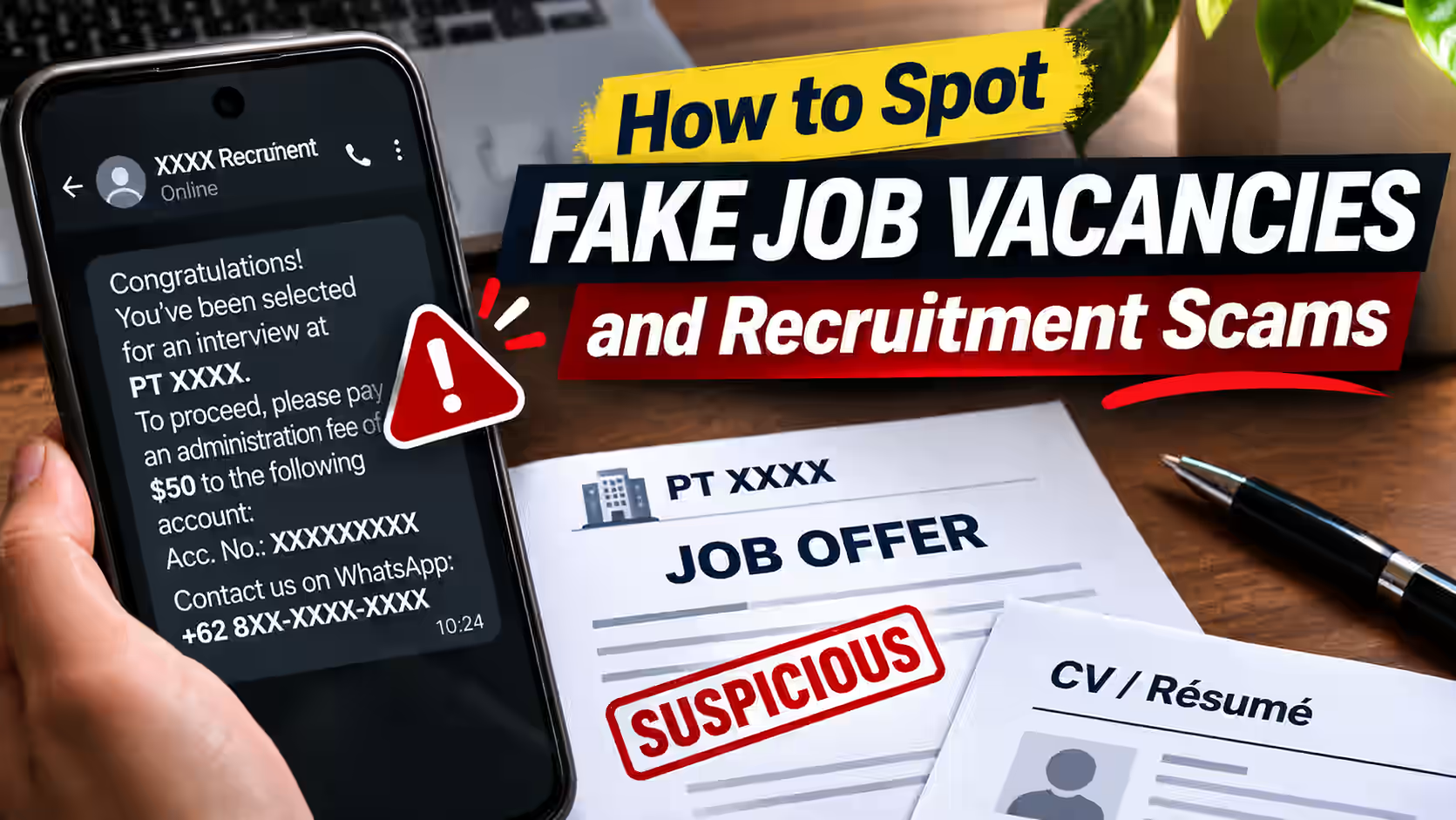
Job scams can appear on job boards, social media, messaging apps and in emails that look like official invitations from employers. Some ask you to pay a fee before an interview. Others try to collect identity documents or banking details. A familiar company logo on an offer letter is not proof that the person contacting you works for that company.
Before following a recruiter’s instructions, establish that the vacancy exists and that the recruiter is authorized to fill it. That is particularly important when someone contacts you unexpectedly or offers remote work that sounds unusually easy.
7 warning signs of job scams
1. You are asked to pay to secure the job
In job scams, upfront charges may be disguised as registration, training, equipment, accommodation or interview fees. The person contacting you may claim that the payment is refundable once you start work. The International Labour Organization (ILO) fair recruitment guidelines establish that workers and jobseekers should not have to bear recruitment fees or related costs. Local laws and their implementation vary, so the guidelines are an international benchmark rather than a single law enforced everywhere.
Paying your own transport costs to reach an interview is different from sending money to a recruiter who promises to reserve a position. If a genuine qualification, medical examination or work permit is required, confirm the requirements independently and use the relevant official or authorized provider. Do not pay someone who guarantees a job in exchange for a fee. The FTC’s job scam guide also warns about counterfeit checks: a supposed employer may send a check and ask you to forward money before the payment is found to be fraudulent. Do not send money on the strength of an apparent credit in your bank account.
2. You cannot verify the recruiter’s identity
Many job scams impersonate real businesses. Check the sender’s full email address instead of relying on the display name. A domain that differs from the company’s website by a few characters deserves closer inspection. The US Federal Trade Commission (FTC) warns about impersonation on job platforms, including convincing interview invitations and offer letters that use an established company’s identity.
A personal email address or a conversation on a messaging app is not conclusive evidence of fraud. Small businesses and legitimate recruitment agencies may use these channels. Contact the employer using details you obtain independently from its official website and ask whether the recruiter actually represents it.
3. The pay is unusually high, but the duties are vague
Some job scams promise substantial earnings for a few hours of simple work without explaining the actual responsibilities. A high salary alone does not make an offer suspicious. The value of a role depends on qualifications, location, industry and the employer’s needs.
Ask what a typical working day involves, how your performance will be assessed, who will employ you and how wages will be paid. Find out whether you are applying for employment or an independent contractor arrangement. A recruiter who can discuss income in detail but cannot explain the job itself has not given you enough information to make a decision.
4. You receive an offer immediately and feel pressured to accept
Hiring timelines differ between employers. A rapid offer becomes concerning when the recruiter has barely assessed your suitability and then insists that you transfer money or send sensitive records before an urgent deadline. Pressure is a recurring feature of job scams because it discourages independent checks.
Recruitment scams can involve signed offer letters, video interviews and professional-looking contracts. Do not treat these as sufficient verification. Documents can be copied, and someone conducting an interview may be pretending to represent a legitimate employer. Request time to review the terms and confirm the vacancy through an independent contact.
5. You are asked for sensitive personal information too early
A résumé or CV, portfolio and contact information are usually appropriate during an initial application. Requests for a passport, national identification number, tax identification details, a selfie with an identity document or bank account information require a clear purpose and a verified recipient. The appropriate stage for collecting such information depends on local employment rules and the role.
An employer may need identity documents for a lawful background check, proof of the right to work or payroll information during onboarding. That does not give a recruiter a reason to ask for your banking password, PIN or one-time verification codes. Job scams that collect these details can expose you to identity theft or unauthorized account access. Never grant remote access to your personal device simply to complete an interview.
6. The recruiter sends suspicious links or software
Job scams may involve counterfeit application forms, sign-in pages or files advertised as assessment software. The website may look familiar while sending your credentials to someone else. An installer from an unknown source can also compromise your computer or phone.
Find the application page through the employer’s official website rather than opening a link sent in an unsolicited message. If an assessment genuinely requires software, confirm its name, publisher and download instructions through the employer’s verified contact. Keep security protections enabled and do not install an unfamiliar application just because a recruiter asks you to.
7. You must deposit money to unlock commissions
Not all job scams resemble traditional employment. Some offer paid online tasks, such as rating products or boosting listings. The FTC’s guidance on task scams explains how a platform can show fictional earnings and demand deposits before allowing workers to continue or withdraw their supposed commissions.
Receiving a small initial payment does not prove that the arrangement is legitimate. If you must top up a balance, transfer cryptocurrency or pay a release fee to access your earnings, stop sending money. Further payments may increase your losses without making any of the displayed earnings available.
How to check job offers and avoid job scams
Fake job offers sometimes use the name of an existing company. Check the business, the vacancy and the recruiter separately before providing documents or accepting an offer.
- Find the employer’s official website yourself and check its careers page. Compare the job title, requirements, location and application instructions.
- Contact the employer or recruitment agency using an independently verified email address or telephone number. Ask whether the named recruiter is authorized to handle the role.
- Check the vacancy against reputable job boards or your country’s public employment service. If the position is not listed, ask the employer directly; some legitimate vacancies are handled privately.
- Search for the company name and the sender’s contact details alongside terms such as fraud or scam. Previous complaints can be useful clues, but the absence of complaints does not establish that an offer is genuine.
- Confirm the employer’s identity and the purpose of any request before uploading confidential documents or making payments.
Consider a hypothetical example: an employer you never applied to invites you for an interview and provides a convincing address, schedule and company letterhead. It also requires you to book travel through a particular agent. Instead of relying on the agent’s assurances, contact the employer through its independently verified details and confirm both the interview and the travel arrangements.
What to do if you are targeted by job scams
If you encounter suspected job scams, avoid opening attachments or following the sender’s instructions. Preserve any evidence you already have, report the listing to the platform and block the contact. If you have sent money or disclosed personal information, take additional steps promptly.
If you have already paid
Contact your bank, card issuer or payment provider through its official support channel. Explain that you were deceived into making the transaction and ask whether it can be stopped, reversed or disputed. The FTC’s recovery guidance explains options for different payment methods. Recovery depends on the circumstances, payment method and local rules; a report does not guarantee a refund.
Keep transaction receipts, account details, dates, payment amounts and the relevant conversation. On a Windows computer, our Windows keyboard shortcuts guide shows how to use Win + Shift + S to capture evidence. Keep the original messages when possible, and avoid posting sensitive financial or identity information publicly.
If you shared personal data or installed software
If you disclosed a password, secure the affected account from a trusted device. Change the password, replace any reused passwords, sign out unfamiliar sessions and enable multi-factor authentication where available. Contact your bank if someone obtained banking credentials or verification codes.
If you installed suspicious software or allowed remote access, disconnect the affected device from the internet and use a separate trusted device to secure your accounts. Review the installed software, run a security scan and seek reputable technical support if necessary. If identity documents were shared, keep a record of what was disclosed and ask the issuing authority or your local identity theft service about appropriate protective steps.
Where to report job scams
Where you report job scams depends on your country. Start with the job platform and the employer whose identity was used. For suspected financial fraud or identity theft, contact your payment provider and the appropriate local police, cybercrime or consumer protection authority. Examples of official reporting services include:
- United States: ReportFraud.ftc.gov, operated by the FTC.
- United Kingdom: Report Fraud for England, Wales and Northern Ireland; contact Police Scotland for cases within its jurisdiction.
- Australia: Scamwatch for scam reports. A report to Scamwatch is separate from an official police report.
If you are elsewhere, use your own country’s official reporting services. Australia’s Scamwatch employment scam guidance also describes warning signs useful to jobseekers beyond Australia. Report any financial loss to your payment provider promptly rather than waiting for the job platform to investigate. After losing money to job scams, be cautious of anyone promising to recover it for another upfront payment.
Keep a simple record of the jobs you apply for, when you apply and which website you use. It makes unexpected interview invitations easier to identify and gives you a reliable starting point when you need to verify an offer.