
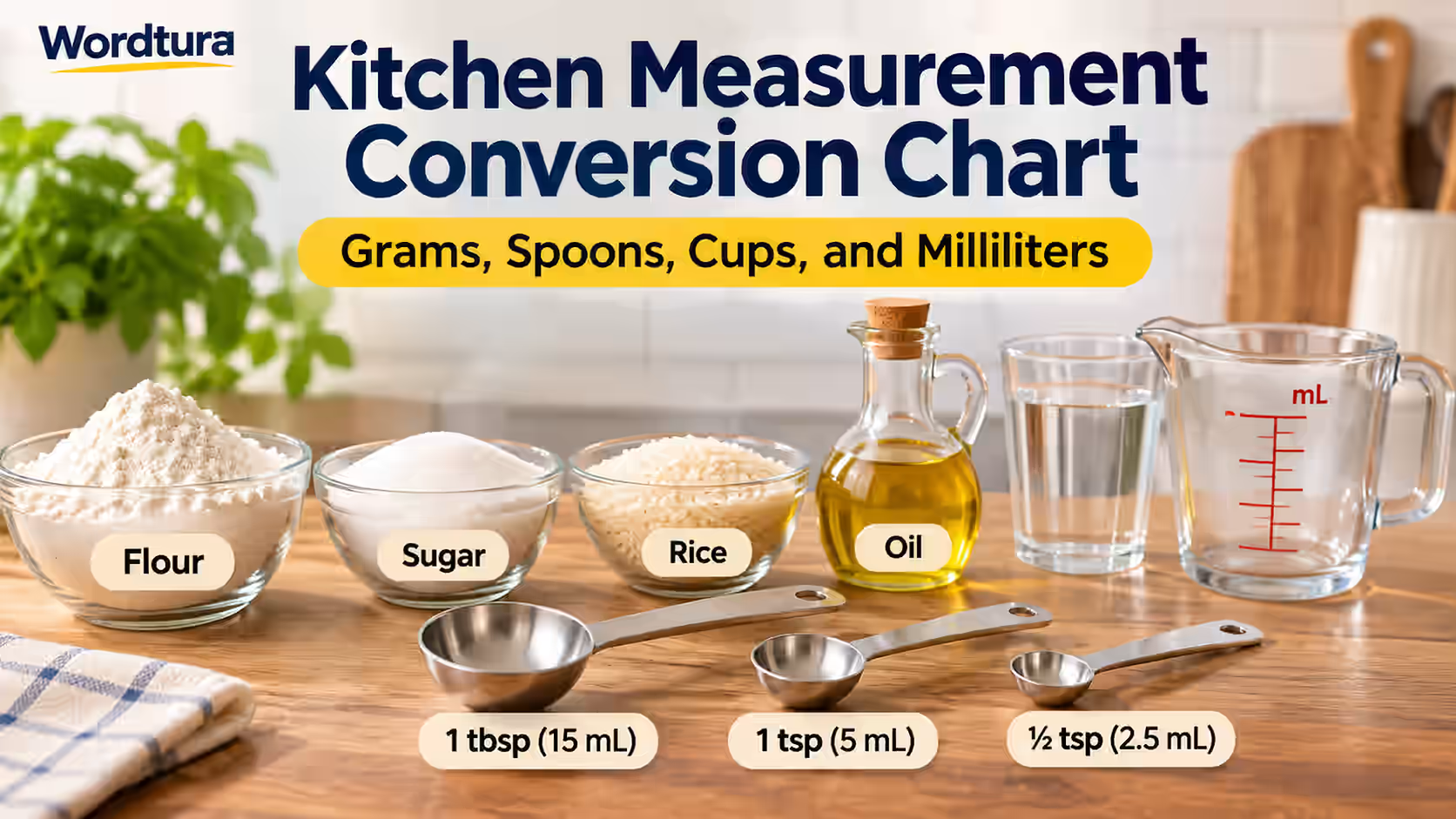
A cake recipe calls for 100 grams of flour, but all you have is a tablespoon. How many spoonfuls do you need? About 13⅓ level tablespoons if you use a reference weight of 7.5 grams per tablespoon of all-purpose flour. For 100 grams of granulated sugar, you need about eight level tablespoons. The right kitchen measurement conversion depends on the ingredient you are measuring.
When converting kitchen measurements, remember that grams (g) measure mass and milliliters (mL) measure volume. Tablespoons (tbsp), teaspoons (tsp), cups, and drinking glasses are measures of volume. A glass of water and a glass of flour can fill the same container without weighing the same amount.
Kitchen measurement conversion chart: spoons and milliliters
I use three practical reference volumes throughout this guide: 1 tbsp = 15 mL, 1 tsp = 5 mL, and 1 cup = 240 mL. These follow the approximate cooking equivalents published by the National Institute of Standards and Technology (NIST). Use measuring spoons with marked capacities rather than ordinary cutlery.
| Measure | Volume | Equivalent |
|---|---|---|
| ¼ tsp | 1.25 mL | ¼ teaspoon |
| ½ tsp | 2.5 mL | ½ teaspoon |
| 1 tsp | 5 mL | ⅓ tbsp |
| 2 tsp | 10 mL | ⅔ tbsp |
| 1 tbsp | 15 mL | 3 tsp |
| 2 tbsp | 30 mL | 6 tsp |
| 3 tbsp | 45 mL | 9 tsp |
| ¼ cup | 60 mL | 4 tbsp |
| ⅓ cup | 80 mL | 5 tbsp + 1 tsp |
| ½ cup | 120 mL | 8 tbsp |
| ¾ cup | 180 mL | 12 tbsp |
| 1 cup | 240 mL | 16 tbsp |
| 1 liter | 1,000 mL | 66 tbsp + 2 tsp |
Here is how to use the kitchen measurement conversion chart: if your recipe calls for 75 mL of milk and you do not have a measuring jug, use five tablespoons. Divide 75 by 15. You can also convert 2½ tablespoons to 37.5 mL by multiplying the number of tablespoons by their capacity. The type of liquid makes no difference when converting one volume unit into another.
How many grams are in a tablespoon?
For conversions from grams to tablespoons, the next chart uses reference weights from the King Arthur Baking ingredient weight chart. I calculated spoon equivalents from the listed cup or spoon weights for each ingredient. The figures are rounded and refer to level measures rather than heaped spoonfuls. The reference cup is the US customary cup, approximately 237 mL, rounded to 240 mL for practical calculations in this guide.
| Ingredient | 1 tsp (g) | 1 tbsp (g) | 1 cup (g) |
|---|---|---|---|
| All-purpose flour | 2.5 | 7.5 | 120 |
| White rice flour | 3.0 | 8.9 | 142 |
| Glutinous rice flour | 2.5 | 7.5 | 120 |
| Cornstarch | 2.3 | 7 | 112 |
| White granulated sugar | 4.1 | 12.4 | 198 |
| Powdered sugar, unsifted | 2.4 | 7.1 | 113 |
| Dry long-grain rice | 4.1 | 12.4 | 198 |
| Fine table salt | 6 | 18 | Not calculated |
| Butter | 4.7 | 14.1 | 226 |
When converting grams to tablespoons, do not treat granulated sugar and powdered sugar as interchangeable measurements. Their particle sizes and the air spaces between them affect how much fits into a spoon. The same applies to salt: larger crystals can change the weight per spoonful. For salt, baking powder, baking soda, and yeast, use a scale capable of measuring small amounts or the measuring spoons specified in the recipe. The figures above are measurement references, not recommended amounts to consume.
Baking powder and baking soda cannot replace each other simply because both are powders. For reference, King Arthur Baking lists about 4 g of baking powder per teaspoon, 3 g of baking soda per half teaspoon, and 6 g of instant yeast per two teaspoons, which works out to 3 g per teaspoon. Avoid rounding fractional spoonfuls of leavening agents up to a full spoon when the recipe calls for less.
Grams to tablespoons conversion chart for flour and sugar
All-purpose flour and granulated sugar are two ingredients you may need to convert when a recipe gives weights in grams. This kitchen measurement conversion chart uses 120 g of flour and 198 g of sugar per cup. Divide each cup weight by 16 to obtain its weight per tablespoon. The results below are approximate numbers of level tablespoons.
| Weight | Flour (tbsp) | Granulated sugar (tbsp) |
|---|---|---|
| 25 g | 3.3 | 2.0 |
| 50 g | 6.7 | 4.0 |
| 75 g | 10.0 | 6.1 |
| 100 g | 13.3 | 8.1 |
| 125 g | 16.7 | 10.1 |
| 150 g | 20.0 | 12.1 |
| 200 g | 26.7 | 16.2 |
| 250 g | 33.3 | 20.2 |
A conversion from grams to tablespoons that gives 13.3 tbsp does not mean you need to guess what a third of a tablespoon looks like. One-third of a tablespoon equals one teaspoon. So 100 g of flour is approximately 13 tbsp plus 1 tsp. For 150 g of flour, you can fill one cup and add four tablespoons. Once you need 20 spoonfuls or more, a measuring cup or scale is much more convenient.
Kitchen measurement conversion for liquids: grams and milliliters
According to the U.S. Geological Survey (USGS), water has a density close to 1 g/mL, with small variations due to temperature and dissolved substances. For everyday cooking, 100 mL of water weighs about 100 g. Oil, milk, honey, and coconut milk have different densities, so that convenient rule for water does not apply to every ingredient.
| Ingredient | 1 tbsp (g) | 1 cup (g) |
|---|---|---|
| Water | ≈15 | ≈240 |
| Whole cow’s milk | ≈15.3 | ≈244 |
| Corn oil | ≈13.6 | ≈218 |
| Honey | ≈21 | ≈336 |
| Canned coconut milk, shaken | ≈15.1 | ≈241 |
The milk and corn oil figures come from a USDA report (Appendix 1, Table 2). The honey and coconut milk figures use the King Arthur Baking chart. Fat content, water content, consistency, and product composition vary, so this kitchen measurement conversion table cannot give an exact weight for every brand. Thin homemade coconut milk, for example, may weigh a different amount from thick canned coconut milk.
If a recipe calls for 30 mL of oil, use two measuring tablespoons. If it calls for 30 g of corn oil instead, divide 30 by 13.6 to get about 2.2 tablespoons. It is an easy distinction to overlook when the numbers look identical but the units differ.
How many milliliters are in a glass?
A regular drinking glass does not have a standard capacity. A recipe that calls for one glass without specifying its size may refer to a 200 mL glass, a 250 mL glass, or another size. In some Indonesian recipes, a drinking glass serves as a measuring tool. For this kitchen measurement conversion example, I use two possible capacities rather than assuming that every glass has one fixed volume.
| Portion of a glass | 200 mL glass | 250 mL glass |
|---|---|---|
| ¼ glass | 50 mL | 62.5 mL |
| ½ glass | 100 mL | 125 mL |
| ¾ glass | 150 mL | 187.5 mL |
| 1 glass | 200 mL | 250 mL |
| 2 glasses | 400 mL | 500 mL |
To estimate grams per glass, multiply the reference weight per cup by the capacity of your glass and divide by 240. With this approximate kitchen measurement conversion, a 200 mL glass holds about 100 g of all-purpose flour or 165 g of granulated sugar. A 250 mL glass holds approximately 125 g of flour or 206 g of sugar. Fill the glass using the same method as you would a measuring cup; these figures are still estimates.
If you want to use a drinking glass as a measuring tool, fill it with water to the intended level and pour the water into a measuring jug. Alternatively, put the empty glass on a scale, zero the scale, and add water to that level. If the display reads about 210 g, the glass holds approximately 210 mL up to that point. Mark the fill line so you can repeat the measurement. In a glass that widens toward the top, half the height does not necessarily represent half the volume.
Check where a recipe comes from, too. The US customary cup is about 237 mL, often rounded to 240 mL, while a metric cup may hold 250 mL. An Australian tablespoon can hold 20 mL, as shown in the NSW Health cooking guide, page 39. Follow the recipe author’s specified volumes whenever they differ from the kitchen measurement conversion chart above.
How to calculate a kitchen measurement conversion yourself
If your ingredient is missing from the chart, look up its weight per measuring spoon or cup. With the appropriate reference value, you can calculate the amount you need without memorizing every possible conversion.
- Grams to tablespoons: required weight ÷ weight of one tablespoon of the ingredient.
- Tablespoons to grams: number of tablespoons × weight of one tablespoon of the ingredient.
- Milliliters to tablespoons: volume in mL ÷ 15.
- Grams to milliliters: mass in grams ÷ density in g/mL.
- Milliliters to grams: volume in mL × density in g/mL.
For example, to convert 80 g of cornstarch from grams to tablespoons, divide 80 by 7 g per tablespoon. That gives about 11.4 tbsp. If you have a scale, weigh out 80 g directly. The fractional spoon measurement is useful when your tools are limited. To halve a recipe, multiply each ingredient amount by ½ before converting its units. Half of 3 tbsp is 1½ tbsp, or 1 tbsp plus 1½ tsp.
Converting units also helps you compare grocery prices. Suppose a 500 g bag of flour costs Rp12,000 and a 1 kg bag costs Rp22,000. The smaller bag works out to Rp24,000 per kilogram, making the larger bag cheaper per kilogram. If a shop offers a promotion, you can use Wordtura’s guide on how to calculate discounts before comparing unit prices.
How to measure ingredients more consistently
The accuracy of a kitchen measurement conversion also depends on how you fill the measuring tool. Scooping flour directly from its bag can pack it down. King Arthur Baking explains that a cup of compacted all-purpose flour can weigh up to 160 g, compared with about 120 g using its recommended method. Follow its guide to measuring flour: loosen the flour first, transfer it gently into your measuring cup, and level off the top without pressing it down.
- Use measuring spoons marked with their capacity, rather than ordinary eating spoons. Level powdered ingredients unless the recipe calls for a heaped spoonful.
- For freely flowing liquids, place the measuring jug on a flat surface and read the graduation at eye level.
- When using a scale, put the empty container on it and press tare or zero before adding the ingredient to the desired weight.
- Distinguish between raw, cooked, and drained ingredients. Water absorbed or lost during cooking affects their weight.
- When a recipe provides both grams and cups, prefer the recipe author’s gram measurement over a generic kitchen measurement conversion.
A kitchen measurement conversion chart is useful when you do not have a scale, but follow the recipe’s specified weight whenever precision matters, particularly for cakes, bread, and leavening agents. Do not use these approximate charts to calculate medication doses, prepare infant formula or oral rehydration solutions, or alter the ratios in food preservation recipes. Use the measurements and tools specified by the product instructions or a tested recipe.