
Stray caught my interest not because of any one feature, but because several elements work well together. I played it on PC with a gamepad, as the game recommends, and finished the main story in about 9 hours and 30 minutes. I bought it on Steam for Rp143,400 during a sale, down from its normal Rp239,000 price. I came away with a very positive impression, although a few things kept it from feeling perfect.
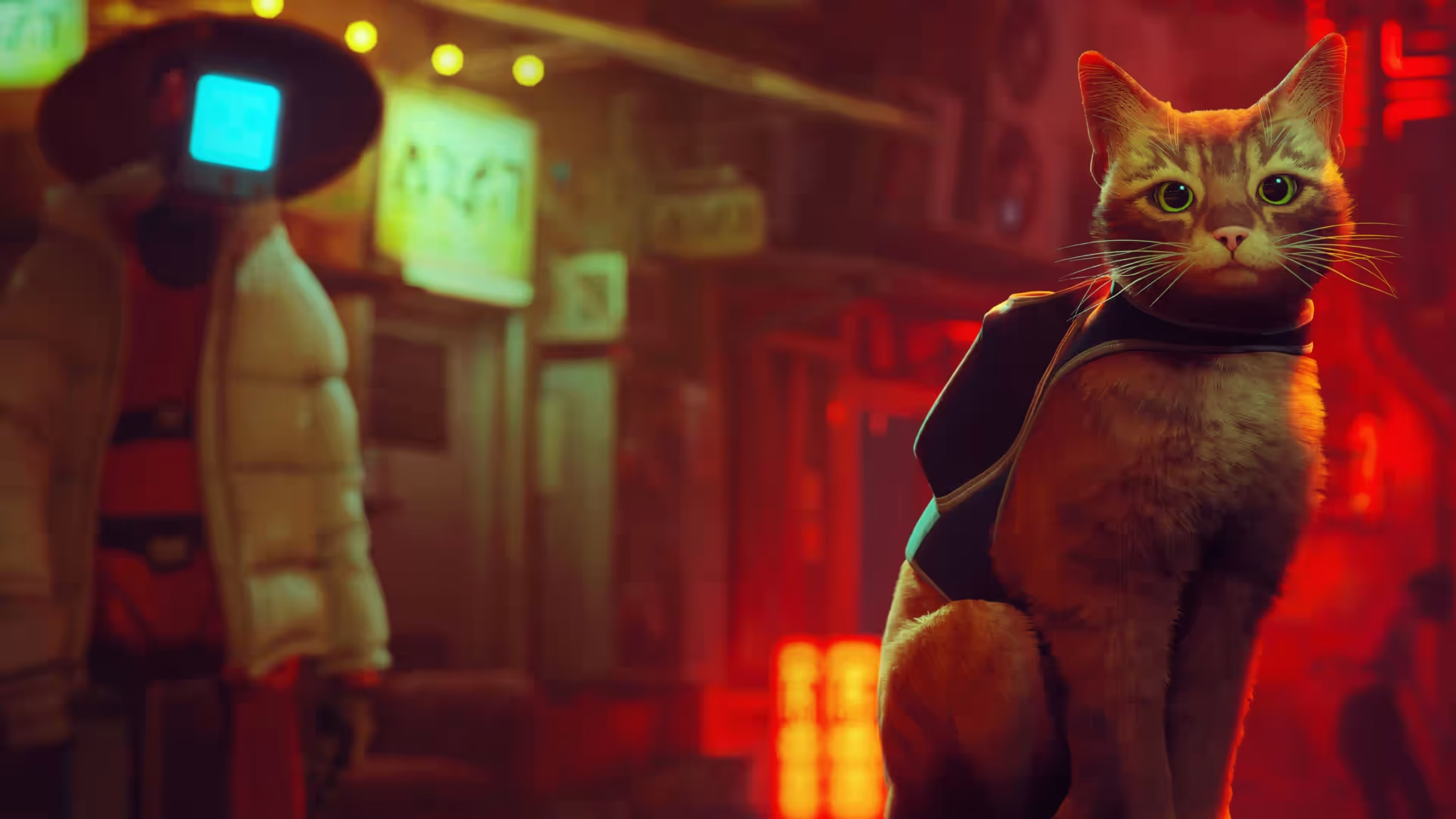
The obvious attraction is getting to play as an orange cat. But after several hours, I realized Stray doesn’t rely only on how cute or unusual its protagonist is. The visuals are pleasant, the world is interesting to explore, the music matches each mood, the story gradually builds curiosity, and the shifts between puzzles, exploration, and chase sequences keep things fresh until the end.
Stray Review in Video Form
Watch my video review below. If you prefer watching to reading, click here to open it.
Stray Gameplay Is Simple but Engaging
Most of my activities in Stray were straightforward. I wandered around gathering information, reading environmental clues, looking for particular symbols or places, solving small puzzles, and moving into the next area. Some sections feel like a miniature detective game because they don’t give you the answer directly and require closer observation.
The pacing felt right to me. Stray was never so slow that I lost interest, but it didn’t rush either. I particularly liked how it gradually increased my curiosity. Early challenges and information are simple. As I progressed, more pieces of the story and tougher situations began forming something larger.
Changes in the type of challenge are well timed. After exploring or solving puzzles for a while, the game often introduces something more stressful, like a chase or a dangerous obstacle. That stops any one style of gameplay from dominating for too long.
Running from the Zurks was one of my favorite parts. I had to think and move quickly, which made the encounters tense. The difficulty wasn’t trivial either. Shifting from relaxed exploration into these sequences made the pacing feel refreshing.
The gamepad controls are responsive and comfortable. They never got in the way. That made basic activities, such as navigating areas, finding routes, and escaping enemies, feel natural.
Puzzles and Exploration: Fun Until You Get Stuck
I didn’t find Stray’s puzzles especially difficult. Most require you to pay close attention to the surroundings. You look for clues, symbols, locations, or objects that allow you to progress. Overall, the difficulty is moderate.
But searching can eventually become irritating. After about ten minutes of wandering without knowing what to do, I start to get bored. It becomes worse when I revisit somewhere I’ve already checked because I missed the right clue. I suspect that’s how the game encourages exploration, but players who struggle with its clues may find it frustrating.
I also found optional puzzles. One example is a safe that asks you to locate a number code resembling binary digits, ones and zeros. I skipped that content because it wasn’t required to finish the main story.
There is also a memory-collection system. It’s optional, but I consider it much more important if you want to understand Stray’s story fully. Missing some memories can make the narrative feel incomplete. That’s interesting for exploration, but a weakness for anyone who wants every story detail without manually hunting for them.
Exploration isn’t extraordinary, but it’s satisfying. I was often tempted to investigate places away from the obvious route because of small, enjoyable interactions. Those details kept wandering around from feeling pointless.
The Cat’s Behavior Makes the World More Enjoyable
What makes Stray easy to remember is the cat’s little behaviors. You can meow at NPCs, scratch surfaces, or knock objects off ledges. These actions are simple, but perfectly suited to playing as a cat.
One interaction that stayed with me involved a sad-looking robot NPC. When the cat meowed at it, the robot’s facial expression turned into a heart. That tiny moment didn’t change the gameplay significantly, but it gave the world personality and made exploration more enjoyable.
My attraction to the cat isn’t mainly about an intense emotional attachment to the character. I enjoy its behavior and the concept of playing as a cat. Stray makes that character central without depending entirely on cuteness.
Stray’s Visuals and World Design Stand Out
Visuals are among Stray’s greatest strengths. They look excellent and have a recognizable identity. Much of the world is bleak and dark, but it also has a strong futuristic cyberpunk mood. That combination makes its environments appealing to look at and explore.
Places with residents feel more alive. Even when an area is quiet, NPCs don’t simply stand around doing nothing. They have their own basic activities, enough to give the impression that people actually live there.
The animations impressed me too. Movement is smooth and polished enough to resemble a high-quality 3D animated film. The orange cat stands out visually because its appearance is immediately familiar and recognizable.
Antvillage was my favorite area in Stray. It felt cozier than anywhere else I visited, with plenty of greenery, places for the cat to relax on cushions, and NPCs who also seem to be taking it easy. The music adds to that feeling.
Compared with other locations, Antvillage doesn’t emphasize the cyber-futuristic aesthetic quite as much. It provides a pleasant change of mood, with a character distinct from the areas before and after it. Its combination of design, NPC activity, and music makes it special.
The UI, menus, icons, and on-screen information are easy to understand. I had no meaningful problems with them. Visually, almost nothing interfered with my experience.
A Simple Story That Gradually Becomes More Interesting
Stray’s story begins simply. A group of cats is traveling together when an incident separates one of them from the others. The lost cat has to survive alone and make its way through dangerous places.
The narrative becomes bigger after meeting B-12. That introduces questions about the location, the outside world, society, and a corporation. I kept wondering who B-12 really was, how it was connected to this place, and what had happened to the wider world.
The story is delivered like scattered puzzle pieces. Information isn’t handed over all at once. You discover fragments gradually, and more of them start connecting as you approach the end.
I think this works because the revelations are well placed. Each section offers something new, preventing the adventure from becoming boring. My curiosity increased naturally rather than being forced from the beginning.
Story pacing is good: not so slow that I grew impatient, and not so quick that I felt I’d missed important details. In my playthrough, I understood there to be five core memory chapters and twelve main chapters, while smaller memories could be missed because they require manual searching.
The story’s strength is that it isn’t overly complicated. Even with a puzzle-like presentation, its main ideas are fairly easy to follow. The weakness lies in the finer details, which must sometimes be found separately. Players who finish with many memories still missing may feel that the story is incomplete.
B-12 Has the Most Character Development
In terms of character development, B-12 changed much more noticeably than the orange cat. The cat continues behaving mostly like a normal cat, although some moments suggest it understands what’s happening around it.
B-12 is different. Throughout the game, it gradually learns about itself. I understood B-12 as a small robot carrying a scanned human consciousness. Technically, I saw it as something like a person without a soul, and that idea made its lore interesting.
The bond between B-12 and the cat grows closer. From the cat’s behavior, I felt that they eventually became almost like family. A particular moment involving B-12’s identity and a sacrifice was one of the story’s most memorable parts, but I won’t explain it because that would be a major spoiler.
A Good but Unresolved Ending
The ending left me with mixed feelings. I don’t think Stray has a bad ending, but I was still disappointed.
The main problem is that the ending doesn’t give enough closure to things the game had been building up. The cat’s goal of escaping is addressed, but I never see it reunited with its group. I could accept that part if the game intentionally left it unseen.
What disappointed me more was the lack of a visual look at the outside world. The game keeps mentioning it and made me curious throughout. When the ending finally arrived, I hoped for at least some visual payoff showing what that world looked like.
Without that, the ending feels unresolved and not quite satisfying after the long journey. Personally, it seems to leave plenty of space for a sequel. That’s only my interpretation, though, not a claim that a continuation is guaranteed.
Music and Audio Suit Every Mood
Audio was almost flawless for me. The music matches the mood beautifully. When things are calm, it supports that calmness. When danger approaches, the music builds tension.
Antvillage is my favorite example, because its music makes the area feel cozy. The sound effects are excellent throughout.
I don’t think conventional voice acting needs a separate rating here. The robots sound like robots and the cat sounds like a cat, so I didn’t treat voice performances in the usual sense as part of my evaluation.
Stable Performance, but I Encountered a Game-Breaking Bug
Stray generally ran well on my PC. Loading times weren’t a problem. But I encountered one serious technical issue that completely stopped my progress.
It happened in a section I know as The Slums Part 2. When I pressed the button to begin a puzzle, instead of starting normally, my cat was thrown out of the map.
The bug was game-breaking because I couldn’t proceed. I immediately emailed the developer or publisher, and received a reply roughly a day later. I considered that an impressively quick initial response.
Unfortunately, I didn’t receive a follow-up telling me when the problem had been fixed. Not knowing when a fix would arrive, I stopped playing for around four months. When I remembered I still hadn’t finished Stray and returned, the bug was gone.
I don’t know exactly when or how it was fixed, whether through an automatic Steam update or something else I missed. So I won’t judge how quickly the bug was resolved. I can only praise how quickly the team responded to my original email.
Apart from that incident, performance was fine and I didn’t encounter other major problems that changed my overall opinion.
Stray’s Price and Value
I bought Stray for Rp143,400 during a sale, down from its regular price of Rp239,000. For what I paid, it was excellent value.
After around 9 hours and 30 minutes of gameplay, I had enjoyed beautiful visuals, a satisfying world to explore, an intriguing story, and excellent audio and music. I don’t regret buying it at that price.
At Rp239,000, however, I’d recommend waiting for a sale. Around Rp150,000 feels like the right price to me. That isn’t because Stray is bad. Quite the opposite. My concern is the length and how much of the content most players will actually experience.
Many searches, memories, and puzzles are optional. I suspect most players will focus on the main story and complete extras only if they stumble across them. After finishing, I had no desire to play again just to collect everything I’d missed. One playthrough was enough for me.
That means value depends less on sheer content length than on the quality of a single journey. Visuals, story, worldbuilding, audio, and music are what made the sale price worthwhile.
DLC and Extra Content
As far as I knew during my Stray playthrough, there was no DLC I needed to include in this review. Everything here therefore concerns the base game and what I actually experienced while completing its story.
Is Stray Worth Playing?
I strongly recommend Stray. I think it can appeal to many kinds of players because the gameplay is simple and most of the puzzles aren’t overly complicated.
It’s particularly suitable for people who enjoy adventure games, slightly unusual mechanics, post-apocalyptic worlds, small puzzles, straightforward exploration, and relaxed gaming. Playing as a cat is also a major attraction, since few other games have given me an experience quite like it.
Players who genuinely dislike puzzles or piecing together story fragments may enjoy it less. Anyone with limited English comprehension could also become confused while reading hints or searching for symbols and locations. Based on my experience, the PC requirements didn’t seem especially demanding, although I’m not evaluating its technical requirements in detail.
For me, the main reason Stray is worth playing goes beyond the cat. The visuals are beautiful, the puzzles aren’t too exhausting, the world is a pleasure to explore, and escaping danger is exciting. These elements work together to make the adventure enjoyable.
Conclusion
After completing Stray in about 9 hours and 30 minutes, I came away very positive. The visuals are a major strength, the world is fun to explore, even simple NPC behavior makes environments feel lived in, music and sound work beautifully, and the story gradually builds curiosity until the end.
Its puzzles are fairly simple but still require observation. Searching for clues can become irritating when you spend too long without a clear direction, but I generally enjoyed the exploration and challenges. Chase sequences also provide a well-timed change from the calmer sections.
The biggest disappointment for me was an unresolved ending that didn’t deliver enough payoff for all the discussion of the outside world. The game-breaking bug that stopped my progress was another bad experience, although I didn’t encounter it again when I returned months later.
At the Rp143,400 sale price I paid, Stray was excellent value. At Rp239,000, I’d personally wait for a discount because of the roughly 9.5-hour campaign and my limited desire to replay it. Around Rp150,000 feels more appropriate.
Even though the ending didn’t fully satisfy me and I don’t feel the need to replay it, I still strongly recommend Stray. Its combination of visual design, story, world, music, exploration, simple puzzles, exciting escapes, and of course playing as a cat makes the journey distinctive and enjoyable.