

If you’ve ever asked the legendary question, “Can it run Crysis?”, you’ll know the series’ reputation. Back in its day, Crysis 3 was both a technical showcase and the finale to Crytek’s FPS trilogy. Now Prophet returns with his Nanosuit in the remaster. I wanted to find out whether the experience still held up when I played it.
Crysis 3 Remastered Review Narrated Video Review
You can watch my narrated review of Crysis 3 Remastered below or open the video here.
Crysis Remastered Gameplay Playlist
Returning to New York with Updated Technology
I first played Crysis 3 Remastered in late 2024. Having finished the original, I was hoping for better visuals, more stable performance, and perhaps a few improvements to how the story was told.Some of those expectations were met, but not all.
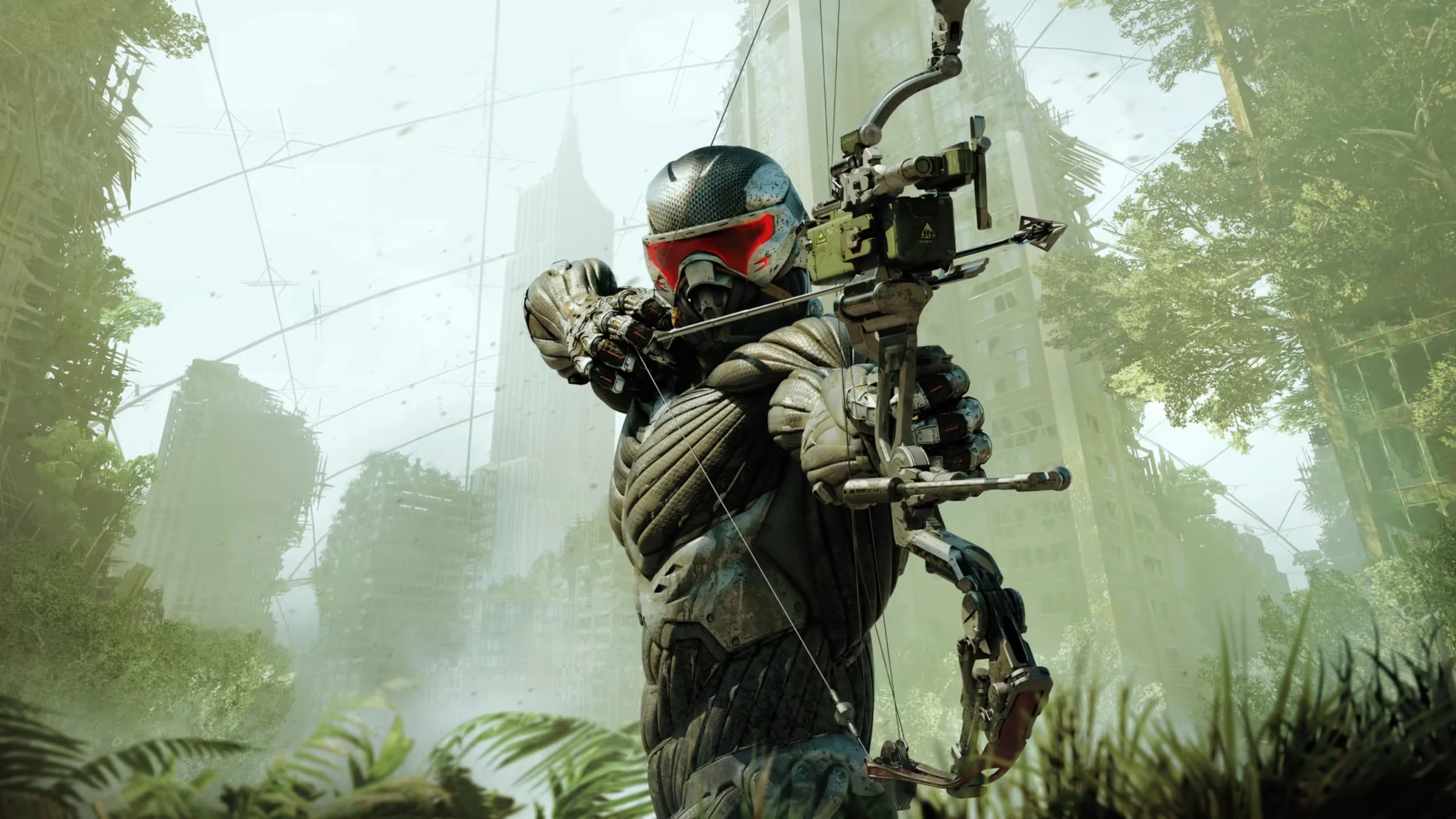
The remaster returns to the ruins of New York, now overrun by dense vegetation and controlled by the oppressive CELL corporation, while the Ceph remain a threat. Prophet, whose consciousness now lives within the Nanosuit, returns for one final mission.
Gameplay: Switch Between Predator and Tank
The flexibility of the Nanosuit is still the best thing about Crysis. I could slip past enemies in Stealth Mode or take heavy fire in Armor Mode. Switching between them is smooth and gives each encounter different possibilities.
The weapon that stood out most was the Predator Bow, a futuristic bow that lets you attack without breaking stealth. I relied on it in almost every mission, especially for distant targets with electric or explosive arrows. It works well with the Nanosuit abilities and encourages a personal playstyle.
Enemy AI hasn’t improved much in this remaster. Enemies can react strangely or be too easy to defeat, and the level layouts feel more restricted than those in some modern open-ended FPS games.
Weapons and Upgrades: Variety Without a Revolution
I enjoyed several of the weapons in Crysis 3 Remastered. Alongside the Predator Bow, Typhoon and DSG-1 offer different approaches to combat.
Typhoon fires at an extraordinary rate and can tear through enemy groups in seconds, while DSG-1 is precise at medium range and useful for stealth-oriented encounters.
I also liked the inclusion of hacking . You can take over enemy turrets, drones, automatic doors, and various Ceph devices to gain a tactical advantage. The system isn’t especially deep, but it makes Nanosuit 3.0 feel more advanced. Still, hacking acts as a supporting feature rather than the core of combat.
The Nanosuit upgrades include modules for defense, offense, and detection, although some barely affected how I played. Nano Vision is the clearest example. Instead of helping me see in dark spaces, it often makes the image harder to read.
I don’t understand why Nano Vision was retained in Crysis 3 and its remaster. It rarely helped me, even in dark areas. Its most useful function was detecting invisible aliens.
But those enemy types appear only briefly early in Crysis 3. In Crysis 2, they become a more serious threat toward the end, after appearing in earlier missions mostly as distant observers.
Compared with Night Vision in the first Crysis, which I found far more practical, Nano Vision was something I switched off more often than I used. It looks sophisticated without being particularly useful.
Story: Redemption and Legacy
Crysis 3 aims to give Prophet’s story an emotional ending. He is no longer entirely human, with his consciousness trapped in a machine, yet he still wants to save the world. His relationship with Psycho and Claire brings out the vulnerability behind that mission.
Some emotional moments work, but others feel rushed. Psycho’s outburst at Claire, for instance, struck me as excessive, even if his history helps explain it.
The ending in Crysis 3 Remastered provides closure without a particularly memorable climax. Laurence Barnes, better known as Prophet, eventually reconciles his identity with the human body of Alcatraz from Crysis 2. But the Ceph threat leaves questions unanswered. When I wrote this review, it was also unclear when Crysis 4 would be released, making the story feel unfinished.
Visuals and Audio: Improvements Without a Generational Leap
Crysis 3 Remastered brings sharper textures, richer lighting supported by ray tracing, and more modern particle effects. Still, judged against games from 2024 and 2025, Crysis 3 Remastered does show its age. Certain areas look impressive, while others feel flat.
Facial expressions and character animations have not improved much, making the cutscenes feel stiff. The ruined city gradually reclaimed by nature, however, still has a striking atmosphere.
Weapons, footsteps, and ambient effects sound convincing and support the combat. The music has a cinematic feel, although none of the tracks stayed with me.I encountered an audio bug during the final boss fight: the climactic music disappeared, leaving only gunfire. It made a scene that should have been dramatic feel strangely empty.
Stable PC Performance
I played Crysis 3 Remastered on a PC with a Ryzen 7 5800X3D processor and RTX 5070 Ti graphics card. Performance was generally stable at 1440p with the highest graphics settings and ray tracing enabled.
Is It Still Worth Playing in 2025?
It depends. For newcomers, Crysis 3 Remastered still offers an FPS experience with a mix of stealth and science fiction that isn’t common in every modern shooter. The gameplay remains enjoyable, the world is interesting, and the Nanosuit feels satisfying to use.
If you’ve already played the original, though, the remaster may feel more like a visual update for nostalgia than a substantial change to the mechanics or content.
I would consider picking it up in a sale, preferably as part of the Crysis Remastered Trilogy rather than as a standalone purchase.
Don’t expect major innovations. Crysis 3 Remastered respects the original, but it doesn’t make the game feel completely new.