
I played SYNDUALITY Echo of Ada on PC through Steam for about 10.8 hours. I bought it on sale for roughly Rp20,000, far below its normal price of around Rp400,000. One thing I need to make clear: I haven’t finished the main story. During those hours, I only unlocked and completed two story missions. This review therefore reflects 10.8 hours of gameplay, not a verdict after completing every part of the game.
Even so, I think more than ten hours is enough to form an impression of what it offers. I didn’t play SYNDUALITY Echo of Ada for a few minutes and rush to a conclusion. I actually lost interest early because of its slow pacing and repetitive gameplay, but pushed myself to continue. I was worried that important features or parts of the story might still be locked.
After 10.8 hours, I felt I’d seen most of the main elements I could reasonably judge. If major features only appear much later, that still points to a progression problem. SYNDUALITY Echo of Ada should introduce its defining features within a reasonable amount of time rather than asking players to spend dozens of hours wondering whether there’s anything different beyond the routine.
SYNDUALITY Echo of Ada Review in Video Form
Watch my video review below. If you’d rather watch than read, click here to open it.
SYNDUALITY Echo of Ada Gameplay Revolves Around Grinding
The main loop in SYNDUALITY Echo of Ada is easy to understand. From the menu, I enter the field for a mission, look for upgrade materials, mine resources, or hunt bandits. Once I’ve collected enough, I return to base to check equipment, complete any missions whose requirements I’ve met, upgrade facilities, and go back to the map to repeat the process.
The biggest problem isn’t that the loop is complicated, but that the activities have so little variety. I keep collecting items, killing bandits, fighting the same monsters, going back to base, and heading out again. I started getting bored after about four or five runs. Mining offered no particular excitement and felt more like a repetitive chore I had to complete to meet the next requirement.
Each run can last around 30 minutes or longer depending on the robot’s battery. But I usually finished in roughly ten minutes. I never stayed in the field until the timer ran out. Inventory capacity has a hard limit, so once my storage was nearly full, I had little reason to remain on the map.
Inventory management itself is simple. Items are easy to distinguish by appearance, and the base carrying capacity feels generous because I didn’t need to bring excessive equipment. Given how unaggressive other players seemed during my sessions, one type of weapon and enough healing items usually felt sufficient. That left room to collect loot.
Unfortunately, finding loot isn’t especially rewarding. Most items feel like materials needed to satisfy mission or construction requirements. Instead of discovering something valuable, I usually felt I was ticking off another item on a to-do list.
A Surprisingly Peaceful Extraction Experience
SYNDUALITY Echo of Ada doesn’t have a feature for forming a team. I played alone, but I could still encounter other players in the field. My interactions were limited to exchanging emotes. Attacking other players is possible, and the tutorial warns you to remain cautious.
Despite that, I never attacked or was attacked by another player during my time with SYNDUALITY Echo of Ada. In my experience, players seemed to follow an unwritten rule not to act too aggressively. Perhaps most were more interested in collecting items and completing field missions than hunting one another.
The possibility of another player attacking remained my main source of tension on the map, although it never actually happened. I also never failed an extraction, so I can’t judge the penalties for losing or losing equipment. I won’t use that untested aspect to claim the extraction risk is either harsh or forgiving.
Responsive Controls, Ordinary Gunplay
The controls in SYNDUALITY Echo of Ada are responsive and fairly simple, much like a typical FPS. There are minor differences, but I adjusted quickly. The tutorial explains the game’s systems clearly enough, although some information arrived after players familiar with similar mechanics might already have worked it out.
Weapons in SYNDUALITY Echo of Ada are grouped by ammunition type: energy and projectiles. The most noticeable difference is their trajectories. Energy shots travel straight, while projectiles can drop over distance. I encountered SMGs, assault rifles, sniper rifles, shotguns, and several explosive weapons. Each weapon type has its own feel.
Overall, however, the shooting isn’t particularly satisfying. It’s hard to identify just one cause. The problem seems to involve bullet impact, animations, audio, and how enemies respond when attacked. The result isn’t terrible combat, just ordinary combat that leaves little impression.
Enemy behavior is mostly predictable. What felt strange was when enemies sometimes seemed to know instantly that I was shooting and automatically dodged. Hunting bandits was the hardest combat activity I encountered. Even then, I can’t point to any fight or gameplay moment I’d call the most enjoyable.
Difficulty gradually increases as your level or missions progress. I noticed changes in enemy numbers, types, and equipment, but don’t know the exact indicator controlling those increases. I suspect monster difficulty might be tied to color, though I couldn’t confirm that either.
Slow Progression and Too Many Requirements
Progression is SYNDUALITY Echo of Ada‘s biggest weakness in my experience. Features unlock through completed missions and building upgrades. During the first few hours, I finally gained access to weapon purchases and basic crafting. By the time of this review, I had only four crafting slots unlocked out of the twelve shown.
Most base upgrades in SYNDUALITY Echo of Ada are cosmetic, although some unlock actual features. You can see the buildings change, so progression isn’t entirely a matter of numbers and menus. The crafting building offered the most noticeable benefit because it directly expanded what I could do. Other upgrades unlocked functions through the menu.
The problem is how many materials are required and how difficult certain ones are to find. Magus sometimes marks materials I’ve already collected or no longer need. The markers indicate general construction needs instead of specifying the exact item I’m seeking, making the search less efficient.
That slow progression is worsened by repeatedly entering the same map. Most runs last less than 30 minutes before I return to base and start again. The map is reasonably large, but after five or six runs I felt I’d explored almost all of it. I could see a second map, but it remained locked, and I didn’t know what I needed to unlock it.
For players who enjoy repeated grinding, this pattern may be the appeal of SYNDUALITY Echo of Ada. For me, however, progression feels like it’s withholding content rather than building healthy curiosity. Having to repeat the same routine before gaining meaningful features gradually turns interest into boredom.
Visuals, Maps, and Magus Design
Overall, SYNDUALITY Echo of Ada‘s graphics are ordinary. The art style didn’t impress me much, and the world design didn’t leave me amazed. Many environmental elements are static; the things you see moving most often are other players and enemies.
That doesn’t mean the maps are bad to explore. The layout is detailed enough and isn’t dominated by empty areas. Searching for resources gives you reasons to investigate different locations. I enjoyed exploring initially, though the appeal faded as I repeatedly visited the same map.
Monster designs lack variety. The Enders look somewhat strange, stiff, and not very appealing in their colors. By contrast, Magus has my favorite visual design. The animations are good, and the UI, menus, icons, and on-screen information are easy to understand.
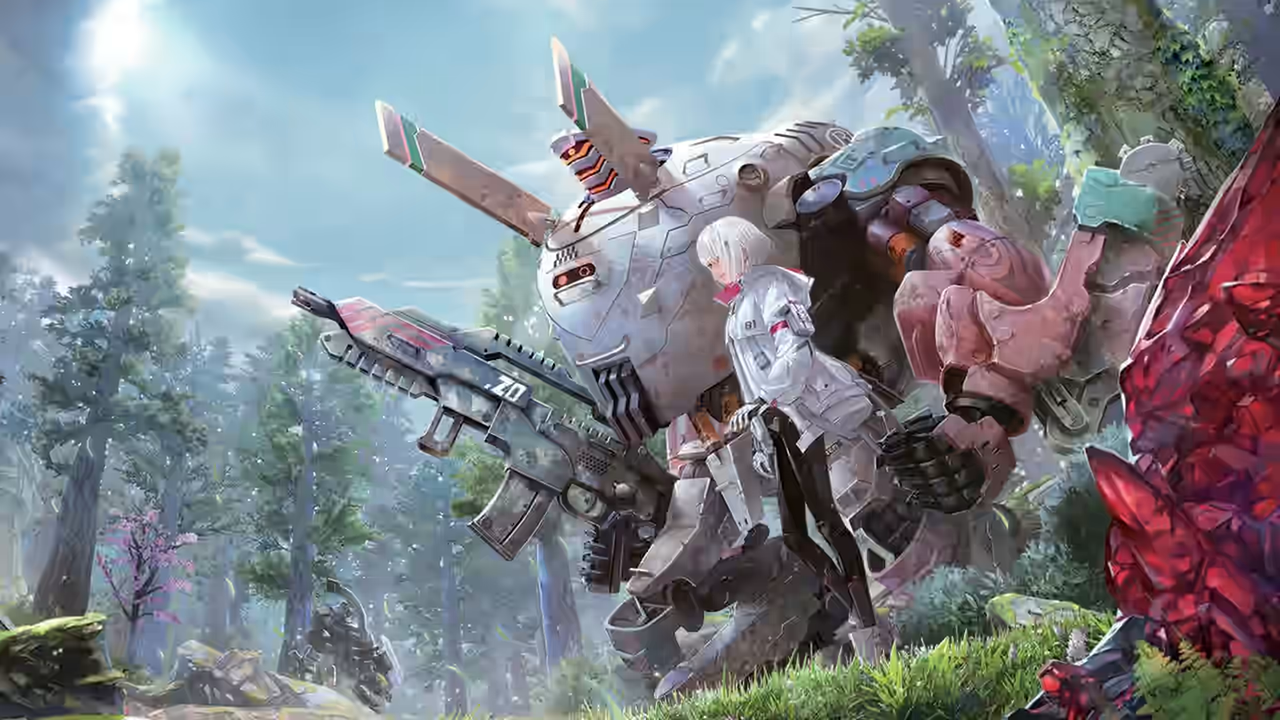
Magus in SYNDUALITY Echo of Ada is more than decoration. It acts as an AI partner providing information while you play. My Magus had an interesting personality and was genuinely helpful. Unfortunately, it talked too much while repeating a limited set of lines. The information mattered, but hearing the same remarks over and over became irritating. The vague item markers also meant its assistance didn’t always match what I needed.
SYNDUALITY Echo of Ada Takes Too Long to Reveal Its Story
From what I understood, the story takes place in a world devastated by the Enders, with Drifters confronting that threat. It seems linked to the destruction of Amasia City. But after the two story missions I completed, I still didn’t understand the story’s overall direction.
At the start of SYNDUALITY Echo of Ada, storytelling is unclear and largely consists of tutorials. The introduction reminded me of a Fallout-style cartoon. After several recorded gameplay sessions, I saw little evidence of a defined main plot. I briefly thought the game might simply be a collection of missions and grinding.
It turned out that field missions are part of the progression required to unlock the main story missions. It took more than six hours for a more clearly presented story sequence to appear. Knowing that the franchise also has an anime, I was pleased to discover the game did have a proper story, which was closer to what I’d expected.
The wait still didn’t feel worthwhile. Once I unlocked a story mission, the narrative became more linear and easier to follow. Each of the two missions ended with a short piece of story in video or audio form. The videos were more interesting because they included animation, while the audio logs felt like scattered mysteries or pieces of an unfinished puzzle.
Investigative storytelling can create curiosity, but here the information is too fragmented and progression toward important moments is too slow. The story missions’ gameplay objectives weren’t particularly interesting either. I hadn’t seen a memorable moment or meaningful character development. The player character and Magus were the only characters who stood out to me.
After those two missions, the story was the only thing still making me consider continuing SYNDUALITY Echo of Ada. But there’s a limit to that interest. If the next story mission requires another long stretch of field missions or building upgrades, I’d probably stop if the requirements became too demanding.
Audio and PC Performance
The background music feels average and leaves little impression. Having music is better than none at all, but no particular piece stuck with me. Sound effects were standard as well. I played with Japanese voice acting, which I also found ordinary.
In terms of performance, SYNDUALITY Echo of Ada ran smoothly and consistently on my PC. During those 10.8 hours, I encountered no bugs, crashes, freezes, or other technical problems. Loading was quick too, since the game was installed on an SSD.
My main technical complaint is the limited graphics settings. I found TAA and FXAA but no DLSS or FSR options. Even so, that limitation didn’t cause noticeable performance trouble during my playthrough.
DLC, Price, and Value
Alongside the base game, Season 4 cosmetics were sold separately through Steam and could be bought later. A battle pass was also available each season, purchasable only in-game. I consider that another form of cosmetic DLC. I didn’t buy either, so I won’t judge their content.
One cosmetic item I saw cost about Rp300,000. I think that’s far too expensive for a cosmetic, especially when the base-game experience wasn’t compelling enough to make me want to spend more.
The value of SYNDUALITY Echo of Ada depends heavily on the purchase price. At the roughly Rp20,000 sale price I paid, I think it’s worthwhile for someone curious enough to try it. More than ten hours of play is acceptable at such a low price.
My opinion changes completely at a normal price of around Rp400,000. I wouldn’t recommend buying it at that price. I found nothing distinctive enough to offset the repetitive loop, slow progression, and limited accessible maps. Waiting for a substantial discount makes much more sense.
Recommendation: A Game for Specific Players
I generally don’t recommend SYNDUALITY Echo of Ada, but that doesn’t mean I think it’s an awful game. The controls are responsive, weapon types feel different, the first map is detailed enough, Magus has an interesting personality, and performance was stable. Unlocking the story also briefly renewed my curiosity.
The problem is that the repetitive structure holds all those strengths back. Loot is mostly a list of required materials, mining becomes a chore, shooting is unremarkable, the same map must be revisited repeatedly, and story progression is far too slow.
SYNDUALITY Echo of Ada might suit players who enjoy repetitive grinding, extraction mechanics, base upgrades, and slow progression. Players who quickly tire of routine or dislike mecha themes will probably struggle. If the first two hours feel repetitive and dull, I think that’s understandable because the fundamental pattern keeps repeating.
Conclusion
After 10.8 hours, SYNDUALITY Echo of Ada left me largely uninterested. I pushed past the early boredom to check whether important features or story content were still waiting to appear. The story did finally begin after more than six hours, but I’d finished only two story missions when I wrote this review.
I’m still a little curious about what happens next. But if reaching another mission means a prolonged grind and more base upgrades, I’m unlikely to continue. Even after uninstalling, I don’t expect I’ll be eager to reinstall it.
At around Rp20,000, SYNDUALITY Echo of Ada remains worth trying for curious players. At its regular price of around Rp400,000, I don’t recommend it. It isn’t entirely bad, but its focus on grinding, repeated activities, and slow progression makes it suitable for a very specific kind of player.